"I don't understand abstract art." We hear this often. And we get it — walking into a room with a large canvas of swirling colour or geometric shapes can feel disorienting if you're used to art that clearly depicts something.
But here's the truth: abstract art isn't meant to be understood intellectually. It's meant to be felt. This guide will help you feel it — and find the right abstract piece for your home.
In This Guide:
What Is Abstract Art, Really?
Abstract art is art that doesn't try to represent reality accurately. It uses colour, form, shape, line, and texture to create visual compositions that communicate emotion, movement, or concept — rather than a literal picture of something.
The abstract art movement began in the early 20th century as artists began questioning whether painting needed to represent the visible world at all. Wassily Kandinsky, Piet Mondrian, and Mark Rothko are among the most famous pioneers. But abstract art has evolved dramatically since then — and today spans everything from playful digital abstracts to raw, textured oil paintings.
"Abstract art is not about what you see. It's about what you feel when you see it."
For your home, this is actually a superpower. Because abstract art doesn't depict specific things, it can be whatever you need it to be — energising, calming, dramatic, or serene — depending on the palette and composition you choose.
The 6 Major Styles of Abstract Art
1. Fluid / Pour Art
Characterised by flowing, organic forms created by pouring, dripping, or swirling paint. Often produces marble-like or oceanic effects. Popular in navy blue, gold, white, and teal palettes.
Best for: Bathrooms, bedrooms, living rooms. Creates a calming, water-like quality. Perfect above a sofa or bath.
2. Geometric Abstract
Clean lines, shapes, and forms — circles, triangles, grids, and colour blocks. Inspired by Mondrian, Bauhaus, and mid-century modern design. Often uses bold primary colours or sophisticated neutrals.
Best for: Home offices, modern kitchens, contemporary living rooms. Works well in pairs or triptychs.
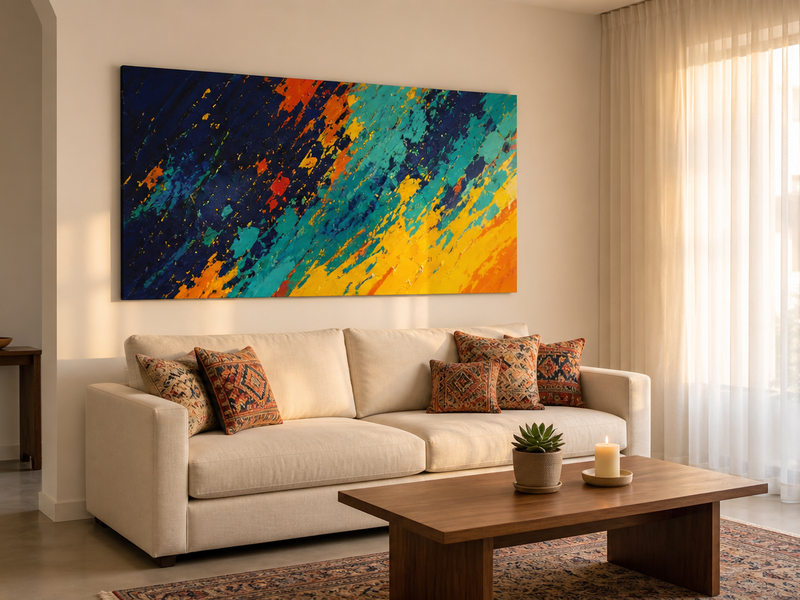
3. Expressionist / Brush-stroke Art
Vigorous, visible brush strokes and raw emotional energy. The most "painterly" of abstract styles. Often uses bold, contrasting colours with thick impasto-like textures.
Best for: Feature walls, living rooms. Makes an immediate emotional impact. Best as a single large statement piece.
4. Minimalist Abstract
Simple forms, limited colour palettes, large negative space. Influenced by artists like Agnes Martin. A single line, a simple shape, a soft wash of colour.
Best for: Bedrooms, meditation spaces, Scandinavian-style interiors. Calming and meditative.
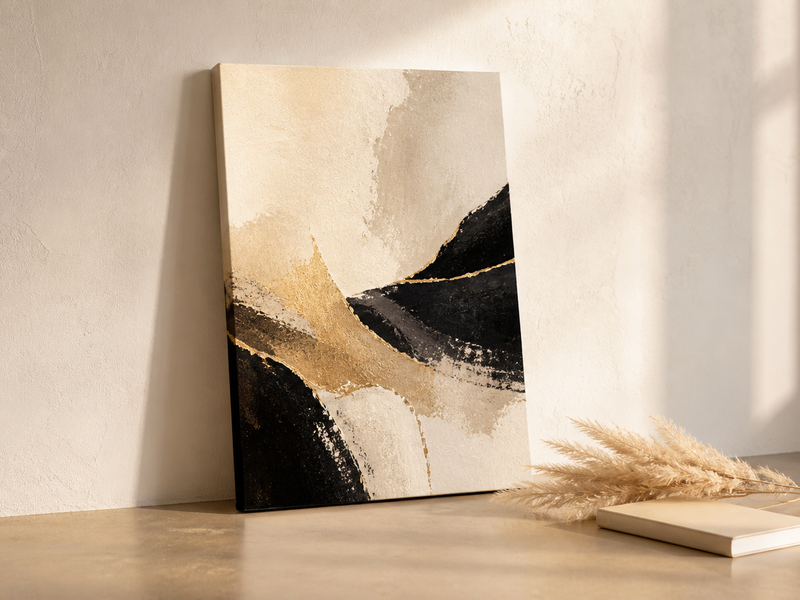
5. Textural / Mixed Media
Art that incorporates visible texture — raised surfaces, layered media, collaged elements. In print form, this is captured beautifully through high-resolution giclée printing on canvas, which preserves the visual depth of original brush strokes.
Best for: Any room that needs warmth and dimension. Looks particularly beautiful with natural light highlighting the texture.
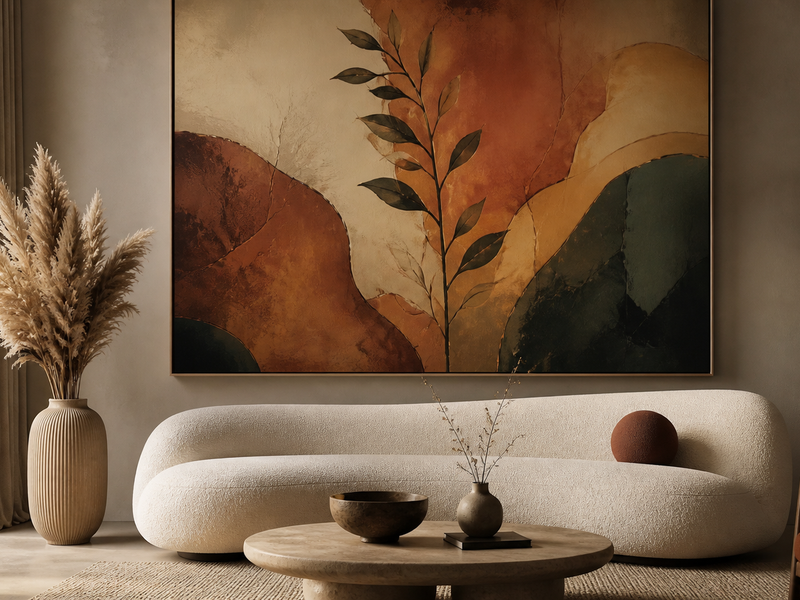
6. Nature-Inspired Abstract
Abstract that takes its cues from the natural world — but doesn't literally depict it. Think abstract landscapes, botanical impressions, geological patterns. The most accessible form of abstract art.
Best for: Any room, any style. The bridge between representational art and pure abstraction. Great starting point for abstract newcomers.
Browse our full range of abstract wall art to find your style.
How to Experience Abstract Art
Forget analysis. Stand in front of a piece and ask yourself three simple questions:
- How does it make me feel? Calm? Energised? Intrigued? Unsettled? Your emotional response is valid data — it's exactly what the artist intended to trigger.
- Where does my eye go first? Notice the focal point. Then notice how your eye moves around the canvas. This is composition at work.
- Does it work with my space? Colour, scale, and mood should complement the room. This is the most practical question — and the one that should drive your buying decision.
✦ The 3-Second Rule: If a piece catches your attention in the first three seconds of seeing it, it's worth considering. Abstract art should have immediate visual impact — that first spark matters.
Choosing the Right Abstract Art for Your Home
Match the Energy, Not Just the Colour
An abstract painting with explosive, frantic brush strokes might share the same blue tones as your bedroom — but it will fight the room's calming function. Match the emotional energy of the art to the function of the room:
- Bedroom: Calm, soft, minimal. Fluid art, minimalist abstract, soft botanicals.
- Living room: Energetic but not frantic. Bold colour, confident composition.
- Office: Focused, inspiring. Geometric, architectural, or motivating colour.
- Bathroom: Serene, fresh. Water-inspired fluid art, soft minimalist pieces.
Go Bigger Than You Think
Abstract art, more than any other category, benefits from scale. A small abstract piece can look uncertain on a large wall. The same composition at 70×100cm becomes a confident, dramatic statement. When in doubt, size up. See our size guide for specific recommendations.
Don't Over-Coordinate
You don't need the art to exactly match your sofa cushions. The best abstract art in a room acts as a conversation partner with the other elements — it echoes some tones, contrasts others, and adds something the room didn't have before.
Where to Hang Abstract Art
Abstract art is particularly powerful in these spots:
- Feature wall above sofa — the most impactful placement. One oversized abstract piece transforms a living room.
- At the end of a hallway — draws the eye down and creates a sense of depth and arrival.
- Above a headboard — waking up to a piece you love sets the tone for the entire day.
- On a dark accent wall — luminous abstract art pops dramatically against charcoal or deep green.
Find Your Abstract at ORLUXE ART™
Our abstract collection is curated specifically for United Sates homes — pieces that work with our light, our spaces, and our taste. Browse now and find the piece that stops you in your scroll.
- 🎨 Shop Abstract Art — full collection
- 📐 Size Guide — find the right scale
- 📖 Room-by-Room Guide — styling by space
- 🌿 2025 Trends — what abstract styles are trending
- 🛡️ Quality & Returns FAQ